 English
 Español
  Português
  русский
  Français
  日本語
日本語  Deutsch
  tiếng Việt
  Italiano
  Nederlands
  ภาษาไทย
  Polski
  한국어
한국어  Svenska
  magyar
  Malay
Malay  বাংলা ভাষার
  Dansk
Dansk  Suomi
Suomi  हिन्दी
  Pilipino
  Türkçe
  Gaeilge
  العربية
  Indonesia
  Norsk
Norsk  تمل
تمل  český
český  ελληνικά
  український
  Javanese
  فارسی
فارسی  தமிழ்
தமிழ்  తెలుగు
  नेपाली
  Burmese
  български
  ລາວ
ລາວ  Latine
  Қазақша
  Euskal
  Azərbaycan
  Slovenský jazyk
  Македонски
  Lietuvos
  Eesti Keel
  Română
  Slovenski


How to Choose the Right Roll-to-Roll Labeling Machine for Your Products?
Many roll material manufacturers, when purchasing roll-to-roll labeling machines, often only compare equipment parameters and quotations, while ignoring their own product substrate, label type, and actual production process. By the time the equipment is installed and put into production, they discover that the roll material is stretched, labeling positions are offset, the machine stops frequently, and expected production requirements cannot be met.
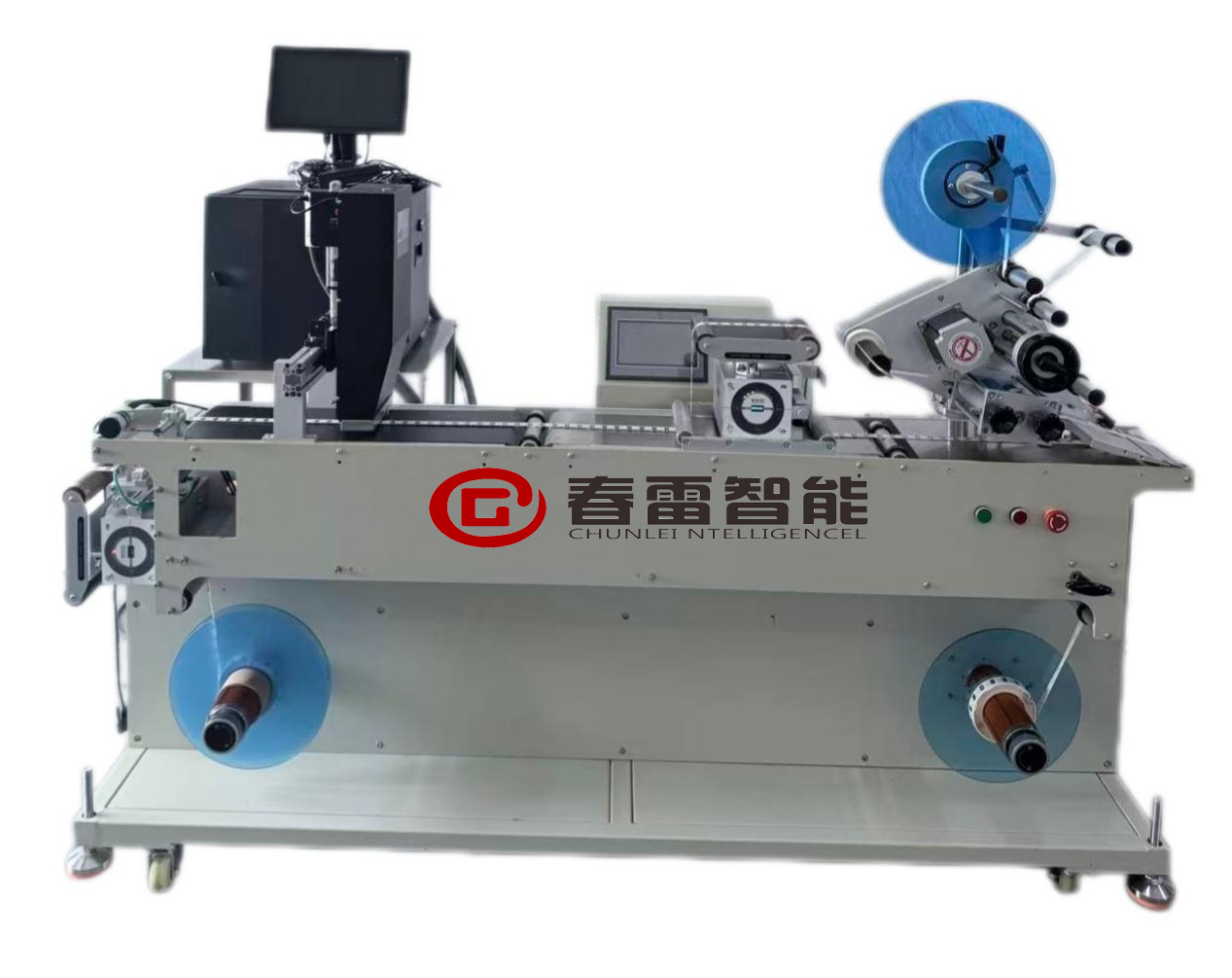
In Chunlei Intelligent's view, choosing a roll-to-roll labeling machine is not about the more expensive or faster the better. The key is whether the equipment can match your product characteristics, process standards, and capacity requirements. Next, we will guide you step by step through the selection process from multiple core dimensions.
First, look at substrate and material compatibility. Different roll materials have completely different requirements for equipment tension and deviation correction systems. Paper and ordinary PVC roll materials are suitable for basic roll-to-roll labeling machines, meeting conventional labeling needs. For ultra-thin and easily stretched materials such as PET film, FPC flexible printed circuits, and medical composite film, it is necessary to choose a roll-to-roll labeling machine with automatic closed-loop tension to effectively avoid material deformation and label misalignment.
Second, determine the model based on labeling precision. For ordinary packaging roll materials and identification labeling, a ±1mm precision model is sufficient. For products with high appearance requirements such as film and anti-counterfeiting labels, an industrial model with ±0.5mm precision is suitable. For 3C electronics and medical UDI precision labeling scenarios, a high-precision roll-to-roll labeling machine equipped with CCD vision correction is required to ensure zero labeling deviation.
Finally, select functions based on capacity and process. For small-batch processing, standard models are more cost-effective. For large-batch 24-hour continuous production, it is recommended to upgrade to a high-speed industrial model. For process requirements such as inkjet coding traceability, visual inspection, and defect rejection, supporting modules can be added as needed to achieve integrated automated production.
If you are still not sure which roll-to-roll labeling machine is suitable for your products, you can tell us the roll material, roll width, labeling precision, and capacity requirements. We can provide free sample labeling tests, professional solution evaluation, and one-stop roll material labeling automation solutions.
Send Inquiry


X
We use cookies to offer you a better browsing experience, analyze site traffic and personalize content. By using this site, you agree to our use of cookies.
Privacy Policy